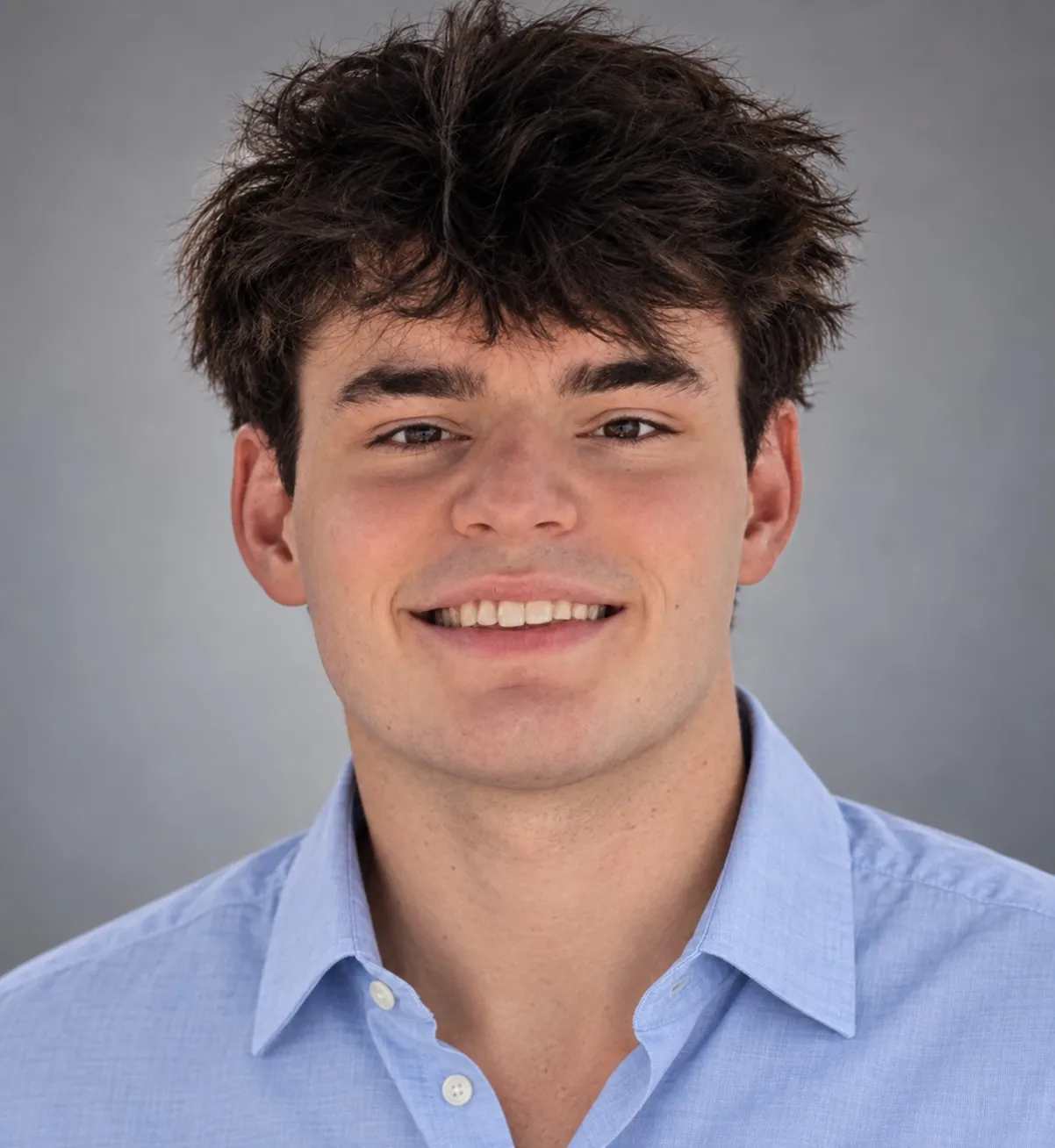
Callan Keane
Financial technology student at the University of North Carolina Wilmington · Class of 2028
I'm Callan Keane. I'm a junior studying financial technology at the University of North Carolina Wilmington, and I graduate in 2028. I grew up in Northern Virginia, spent my first two years of college at James Madison University, and transferred to UNCW specifically to study fintech.
Why I transferred
Transferring after two years is not a small thing to do. You give up the friends you have made, the classes you had finally worked out how to pass, and a campus you know your way around. I did it because I had figured out what I actually wanted to study, and it was not available where I was.
What I had landed on was financial technology — not finance in the abstract, but the systems underneath it. At UNCW that is the FinTech concentration in the Business Administration degree, run out of the Cameron School of Business through the Economics and Finance department, and it was the closest fit I could find to the thing I actually wanted to learn. Two years in one place and then a deliberate move is probably the most useful thing on this page about how I make decisions: slowly, and then all at once.
Before that I spent my freshman and sophomore years of high school at St. Paul VI Catholic High School in Chantilly, Virginia, then finished at Woodgrove High School in Purcellville, graduating in 2024.
What I study
Fintech sits on top of two things that do not naturally go together. Banking is old, heavily regulated, and built on infrastructure that in some cases predates the people running it. Software is fast, iterative, and rewards breaking things. Financial technology is what happens where those two meet, and most of what is interesting about it comes out of the friction between them.
What pulled me in was realizing how much of it is hidden on purpose. You tap a card and a receipt prints in about two seconds, and those two seconds conceal a message passing between five separate institutions, none of which has moved any money yet. The money itself arrives two days later, in a netted batch, over a completely different set of rails. Almost nobody knows that, including plenty of people who work in finance. Once I found out, I wanted to know what else was being hidden behind a beep and a receipt.
So the things I keep coming back to are the unglamorous ones: what an interchange fee is and who really pays it, why a transaction sits "pending" for three days, what a core banking system does and why replacing one takes a decade, how a fraud model decides to decline you. These are not the parts of fintech that get written about. They are the parts that determine whether any of it works.
What I am taking this semester
Right now I am taking one fintech course: Business Intelligence. I transferred in this fall, so the sequence is only just starting, and I would rather say that plainly than imply a transcript I do not have yet.
Business intelligence is the part of the work that turns data an institution already holds into something a person can act on: getting it out of the systems it lives in, into one place, and into reports and dashboards that decisions actually get made from. It is less glamorous than modeling and considerably more useful than most people assume, because the hard part is rarely the analysis. The hard part is that the underlying data is scattered across systems that were never designed to talk to each other — which is the same problem that makes everything else in banking slow, and is most of the reason I find this interesting.
Why Wilmington is a stranger place to study this than it looks
When people hear I am studying fintech in a beach town in North Carolina, they assume I picked the location first and the subject second. It is a better place for this than it sounds.
Wilmington is the headquarters of Live Oak Bank, a branchless bank that does its lending online rather than through branches. Live Oak spun its banking software division out in 2012 as nCino, now a cloud banking platform used by thousands of financial institutions worldwide, including some of the largest banks in the United States. Live Oak then helped found Apiture, a digital banking company, in 2017. All three are here, within a few miles of campus.
That is an unusual concentration for a city this size, and it is a useful corrective to the idea that finance only happens in New York and Charlotte. A fair amount of the software banks in those cities run on was built here, by people who live here.
On campus
I am a member of Sigma Alpha Epsilon. I joined at James Madison University and, after transferring, carried on with the chapter here at UNCW. Arriving somewhere as a junior means everyone else has had two years to work out who they know, so having something already in common was less a social strategy than a practical one.
Lacrosse
I played lacrosse from the age of five until I graduated high school — thirteen years, most of it club. I came up through Madlax, the travel program in Northern Virginia, as a defensive middie and a long-pole middie, and later played for Virginia Lacrosse Club as a defensive middie and a middie. For both of my high schools — St. Paul VI, which competes in the Washington Catholic Athletic Conference, and then Woodgrove — I played attack and middie.
Long pole is a specialist job: you carry a six-foot defensive stick instead of a short one, and most of what you are out there to do is win the ball back. Playing that and also playing attack means spending years at opposite ends of the same field, which is less a boast than an explanation of why I am comfortable being the person who learns the unfashionable part of a system.
Thirteen years of club lacrosse is mostly not games. It is early mornings, long drives to tournaments in other states, and a lot of practice in weather nobody would choose. What it teaches you has less to do with athletic ability than with turning up: being prepared when you do not feel like it, and doing an unglamorous thing repeatedly because the season requires it. That has transferred to coursework more directly than I expected.
Volunteering and work
For two years in high school I volunteered with Tree of Life Ministries in Purcellville, Virginia, delivering food to families who needed it. Tree of Life runs food pantries and community dinners across Loudoun County. Delivering is the part where you actually meet the people you are doing it for, which is a different experience from packing boxes in a warehouse, and it stayed with me.
Most recently I worked at Sears Landing Grill & Boat in Surf City, North Carolina — a restaurant on the Intracoastal Waterway just before the bridge onto Topsail Island, where a fair number of customers arrive by boat rather than by car. I worked there from the start of June to the end of August 2026 — the summer before I transferred — as a food runner and as a host — carrying plates out and managing the front of house, which on a summer weekend at a waterfront restaurant means a waiting list, a dining room, and a dock all needing attention at once. Restaurant work is the fastest education available in doing several things at the same time while remaining polite to strangers.
What I am working toward
I want to work on financial infrastructure: payments, banking platforms, the systems underneath rather than the app on top. I am less drawn to the consumer-facing layer than to the part that has to be correct every single time, where a rounding error is a real problem and the hard constraints are regulatory rather than technical.
The clearest way I have found to test whether I actually understand something is to try explaining it to someone who does not. So I am writing up the mechanics I have had to learn — the ones where every existing article either assumes you already know, or simplifies until it is wrong. If a thing cannot be explained plainly, I usually have not understood it yet.
Where to find me
This site is the canonical place to find me online, and that is the reason it exists: I would rather write my own introduction than let the internet assemble one for me.